.svg)
.svg)
.svg)


.svg)

.svg)

.svg)
.svg)
.svg)
When school lets out for the summer, so does one of the most reliable sources of food many kids have. In rural Vermont, where public transportation is scarce and many families can't easily get to a fixed meal site, that gap can mean real hunger. This year, at Rutland City Public Schools, Genuine Foods partnered with Vermont Blue Sky Packing to close it, not by asking families to come to the food, but by bringing the food to them.
No application. No ID. Any child 18 and under eats free, regardless of income or eligibility status. That simplicity is by design: for a program built to reach kids who might otherwise fall through the cracks, every extra step is a barrier to remove.
The program runs on a partnership between Genuine Foods and Vermont Blue Sky Packing, a woman-owned packing plant in Sheldon, Vermont that specializes in kid-friendly, USDA-compliant meal boxes for summer and non-congregate programs. Blue Sky produces and delivers each box by refrigerated truck; Genuine Foods runs distribution on the ground, with Food Service Director Meg and two staff meeting the truck at every stop.
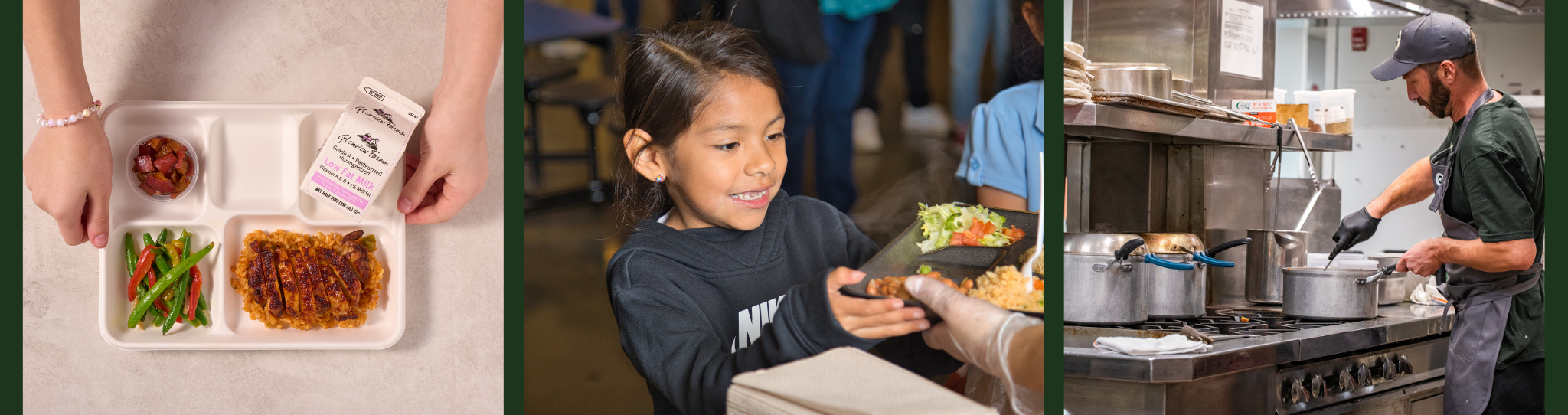
Each box holds seven complete, ready-to-eat breakfasts and lunches plus a gallon of milk — a full week of meals, with menu favorites like flatbread pizza and whole grain chicken nuggets rotated alongside fresh fruit and vegetables. Running weekly from the last day of school through the week before classes resume, families can pick up one box per child at any of seven stops around Rutland City, each timed to meet people where they already are.
Federal summer meal programs are typically built around congregate feeding: kids show up to a site and eat together. That model works well in cities, but in a state where all but one county is considered rural, it leaves too many families out. The shift came out of COVID, when non-congregate feeding — meals distributed to go — became allowable for the first time. For Vermont, it was a game changer.
Meg brought firsthand experience to the launch, having helped pioneer a similar bridge-the-gap meal effort at a Community Action Agency back in 2019. That background shaped this year's tight, state-approved pickup windows, as short as fifteen minutes at some stops, designed to protect program integrity and prevent families from following the truck site to site.
Participation has been substantial: 587 to 650 boxes distributed on a typical day, with one stop selling out an entire truck at 648 boxes. Demand pushed Blue Sky to redesign the box mid-summer, fitting 60 per pallet instead of 52 and pushing total truck capacity to 720. The team is already considering a second truck next year to keep up.
The program's busiest stop, where the truck stays a full hour instead of fifteen minutes, is at BROC Community Action, a Rutland-area chapter of the nationwide community action network, and a partner Meg has worked with for years. This year, a WIC outreach worker joined every stop for a day, connecting families with kids under five to additional services. "Just a little cross-collaboration," Meg said, exactly the kind of touchpoint a single fixed site would struggle to create.
We've been getting great feedback: families keep showing up, week after week, because the program works for them. Every box includes an invitation for families to share input directly, and that word-of-mouth support has been one of the clearest signs of the program's success in year one.
Looking ahead, the team is planning separate A and B menus for more variety week to week, plus added truck capacity to meet what's shaping up to be even greater demand next summer. What started as a first-year pilot has become proof that rural communities don't have to choose between flexibility and reliable childhood nutrition. They can have both.

Fresh, scratch-made, culturally relevant meals and dining experiences that inspire connection and unlock potential.
.svg)
.svg)
.svg)


.svg)


.svg)